
There is a moment every car owner experiences, though most don’t notice it at first. You wash your car on a Sunday morning, step back, and something feels… different. The shine is not the same anymore. The paint doesn’t reflect light like it used to. And for a second, you convince yourself it’s just dust.
But deep down, you know something is changing.
That is usually the first quiet signal that your car is asking for paint protection—not later, but urgently.
Let’s understand this in a real, practical way, not as theory, but as something you might already be seeing in your daily life.
1. The shine is fading faster than before
Do you know that a healthy car paint surface should hold its gloss for years if maintained properly? Yet many owners notice dullness within months.
If your car looks shiny immediately after washing but loses that glow within a few days, that is not normal aging—it is early surface oxidation. This is one of the earliest signs you need paint protection.
Sun exposure, pollution, and improper washing techniques slowly break down the clear coat. Once that layer weakens, the paint starts losing depth and richness.
And here’s the truth: once oxidation becomes visible, restoring it is harder than preventing it.
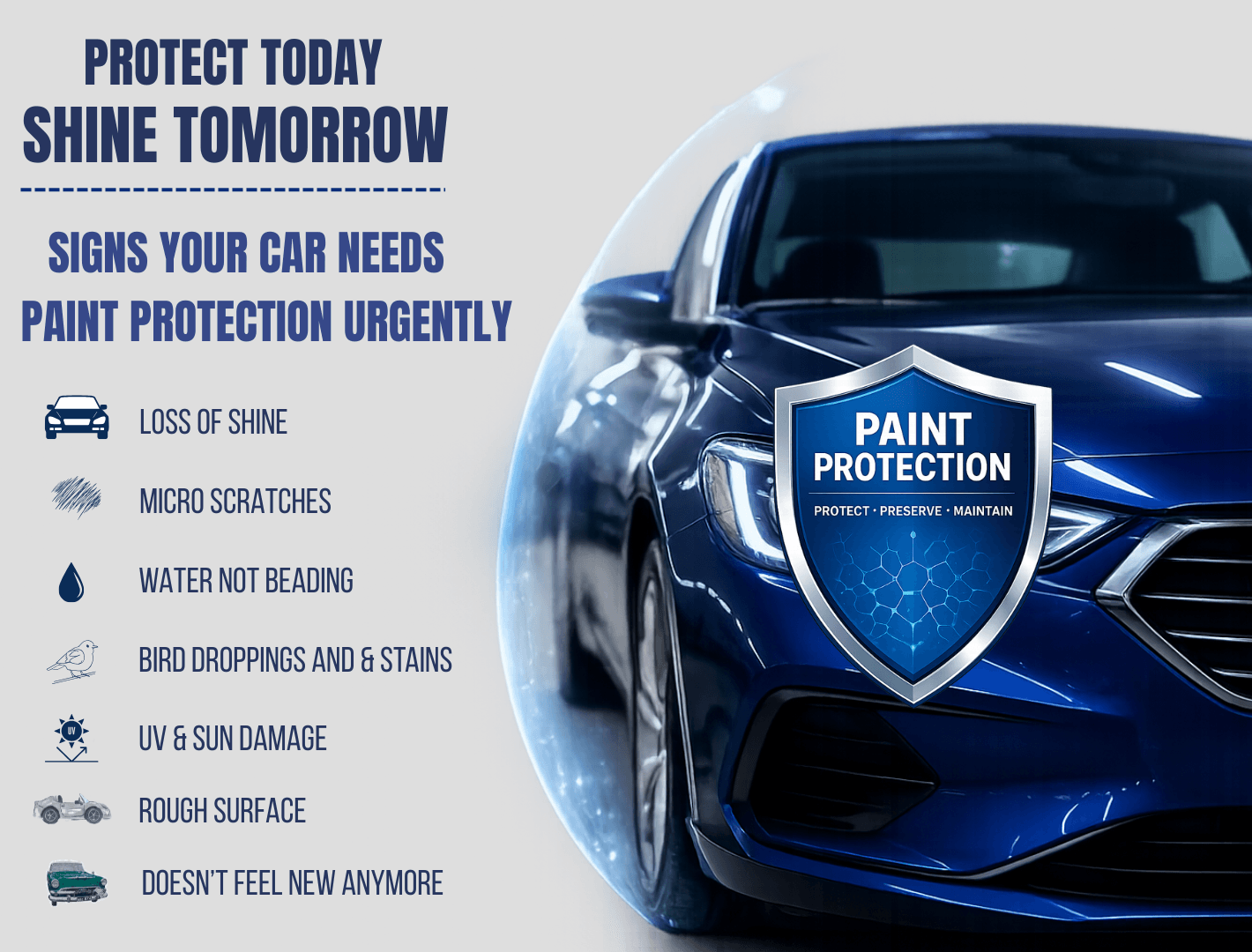
2. Micro scratches are becoming visible under sunlight
Have you ever looked at your car under direct sunlight and suddenly noticed swirl marks that were never visible before?
That is not your imagination.
Those tiny circular marks usually come from improper washing, rough cloth, or automatic car washes. Over time, they accumulate and dull the surface.
This is where car paint protection becomes important. Without a protective barrier, every wash slowly adds more micro-damage.
Professionals often say: “If you can see swirl marks easily, the surface is already unprotected.”
3. Water no longer beads properly
Here is a simple test anyone can do.
After washing your car or during rain, observe how water behaves on the surface.
If water used to form tight beads and now spreads flat or sticks to the surface, that is a major warning sign.
Hydrophobic behavior is a key indicator of surface health. Loss of this effect often means your paint’s protective layer is gone or significantly weakened.
At this stage, paint protection is not optional anymore—it is necessary to prevent long-term staining and etching.
4. Bird droppings and stains are leaving permanent marks
Do you know that bird droppings and tree sap can start damaging car paint within hours?
Yes—hours, not days.
These contaminants are highly acidic and can etch into the clear coat if not removed quickly. If you are noticing stains that don’t come off easily even after washing, your car surface is already vulnerable.
This is one of the strongest indicators that paint protection is urgently needed.
A proper protective layer acts like a shield, giving you time to clean contaminants before they cause permanent damage.
5. Your car is parked outdoors most of the time
Let’s be honest for a moment.
Not everyone has covered parking.
If your car is exposed daily to harsh sunlight, dust, rain, and pollution, then it is constantly under attack. In cities, UV index levels often remain high throughout the year, which accelerates paint degradation.
Real-world automotive care studies show that UV exposure is one of the top reasons for long-term paint fading and oxidation (3M Automotive Care Insights).
In such conditions, delaying paint protection only increases long-term restoration costs.
6. The surface feels rough to touch
Here’s something most people don’t check.
Run your hand gently over the car after washing it.
If it feels smooth like glass, your paint is still in good condition.
But if it feels slightly rough or gritty, that means contaminants are embedded on the surface. This is a clear sign the clear coat is no longer fully protected.
At this stage, professional car paint protection becomes essential to restore surface smoothness and prevent further contamination bonding.
7. The car doesn’t feel “new” anymore—even if it is
This is more emotional than technical.
You might still own a relatively new vehicle, but something about it feels older than it should.
The shine is inconsistent.
The color looks slightly dull in certain lighting.
The pride you felt initially is fading slowly.
That emotional shift is real. And it usually aligns with physical paint degradation.
This is exactly when paint protection can bring the “new car feeling” back—not by changing the car, but by preserving what is already there.
Why this matters more today than ever
Modern driving conditions are not the same as they were even five years ago.
Increased pollution, acidic rain patterns, industrial dust, and longer traffic exposure times mean your car’s exterior is under constant stress.
According to global detailing trends, demand for protective coatings and surface treatments has increased steadily as owners keep vehicles longer and expect better long-term appearance retention.
That’s where car paint protection is becoming less of a luxury and more of a maintenance decision.
What happens if you ignore these signs?
Let’s be very direct.
If these signs are ignored:
- Fading becomes permanent
- Swirl marks deepen into visible scratches
- Cleaning becomes harder over time
- Resale value drops significantly
Restoration is possible, but it costs more time, effort, and money than prevention.
And this is where most car owners realize too late what could have been avoided early.
Final thoughts
If you are noticing even two or three of these signs, your car is not just “getting old”—it is asking for attention.
Paint protection is not about making a car look shiny for a few days. It is about preserving the identity of the vehicle for years.
Sometimes, the real question is not “Should I protect my car?”
It is “How long can I afford not to?”
Because once damage becomes visible, you are no longer maintaining paint—you are repairing it.
And that difference is far more expensive than most people expect
for more information