
Introduction: A New Era of Mobility
As we stand on the threshold of April 1, 2026, the Indian automotive industry is no longer just chasing volume; it is chasing value. Financial Year 2027 marks a significant “pivot point” for the sector. We have moved past the post-pandemic recovery phase and entered an era of “Pragmatic Premiumization”. For the average consumer and the seasoned investor alike, this year represents a sophisticated blend of technological maturity and regulatory rigor. While the “new car smell” remains enticing, it now comes bundled with advanced safety suites, localized green tech, and a slightly higher price tag. This blog explores the shifting gears of the industry as it navigates a landscape defined by SUV dominance, EV localization, and evolving fiscal policies.
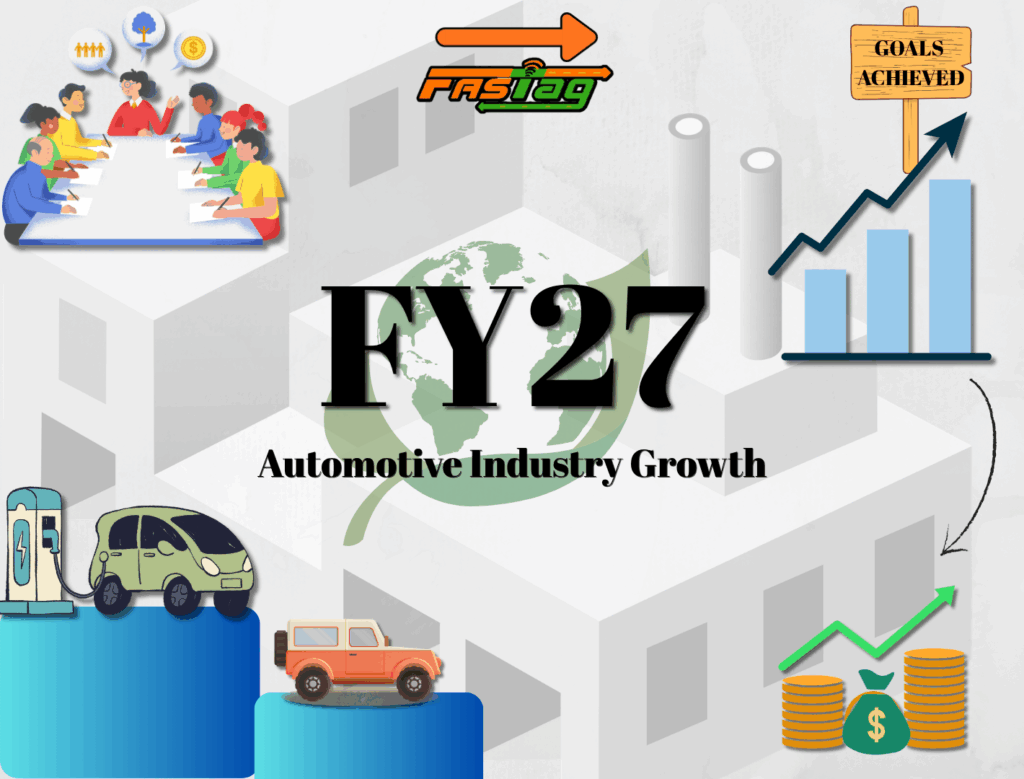
Segment-Wise Performance: The SUV and Premium
The market sentiment for Financial Year 2027 is characterized by moderate, steady growth, with overall wholesale volumes projected to expand by 3% to 6%. However, this average masks a massive divergence between segments.
The SUV Takeover
Utility Vehicles (UVs) have officially moved from being a trend to becoming the industry’s backbone. In Financial Year 2027 , SUVs are expected to command over 50% of the total passenger vehicle market. Consumers are increasingly prioritizing high ground clearance, commanding road presence, and the “lifestyle” appeal of SUVs over traditional sedans and hatchbacks.
Premiumization in Focus
The luxury and premium segments are witnessing a “golden run.” Manufacturers like Audi, BMW, and Mercedes-Benz are reporting record-high interest, even as they implement price corrections. This surge is driven by a growing class of high-net-worth individuals and a psychological shift toward “quality over quantity.” Private four-wheelers in the ₹15 lakh to ₹40 lakh bracket are seeing the most aggressive feature updates, including panoramic sunroofs and Level 2 ADAS (Advanced Driver Assistance Systems).
The April 1 Reality: Price Hikes and FASTag Shifts
New fiscal years often bring new costs, and Financial Year 2027 is no exception. Several immediate changes will impact the cost of ownership starting April 1, 2026.
Manufacturer Price Revisions
To offset rising input costs, logistics expenses, and a depreciating Rupee, major manufacturers have announced price hikes ranging from 0.5% to 6% for Internal Combustion Engine (ICE) vehicles.
- Tata Motors: Implementing a weighted average increase of 0.5% on its passenger vehicle portfolio.
- Luxury Players: Audi and BMW have signalled hikes between 2% and 4%, while Mercedes-Benz has indicated adjustments up to 6% on select high-end models. VIST
The FASTag Annual Pass Hike
For the frequent highway traveller, the FASTag Annual Pass for personal vehicles has been revised to ₹3,075 (up from ₹3,000). This pass, valid for one year or 200 crossings, remains a critical tool for the government to fund the massive ₹12.2 lakh crore infrastructure capex announced in the recent budget. It is a small price for the “seamless travel” promised by India’s expanding expressway network.
Find more details
What This Means for Car Buyers
For car buyers, Financial Year 2027 means better technology and safety, but slightly higher prices due to innovation and regulatory changes. While the cost of ownership may rise slightly, consumers will benefit from improved features, stronger safety standards, and better overall driving experience.
The EV Tipping Point: Localization is the Key
Financial Year 2027 is being hailed as the “Tipping Point” for Electric Vehicles (EVs) in India. The narrative has shifted from “Will EVs work?” to “How fast can we build them here?”
Manufacturing and Mineral Security
The Union Budget 2026 provided a massive boost by extending customs duty exemptions on capital goods used for lithium-ion cell manufacturing. This is a game-changer for battery cost reduction. Furthermore, the government’s focus on lower duties for EV minerals like Lithium, Cobalt, and Nickel ensures that India is building a “shield” against global supply chain shocks.
Infrastructure and Adoption
With the expansion of the PM-eBus Sewa and a target to cross 70,000 public charging points this year, the ecosystem is finally catching up to the technology. As battery costs fall due to localization, the price gap between EVs and ICE vehicles is narrowing, making the “Total Cost of Ownership” (TCO) highly attractive for urban private owners.
Regulatory and Safety Impact: CAFE III and ADAS
Safety and sustainability are the twin pillars of the FY27 regulatory framework.
- CAFE III Norms: The industry is bracing for Corporate Average Fuel Efficiency (CAFE) III standards. These norms mandate a fleet-wide reduction in CO2 emissions, effectively forcing OEMs to balance their portfolios with more hybrids and electric models.
- Advanced Safety: Mandatory ABS and Advanced Safety/ADAS are no longer restricted to luxury cars. In FY27, we see these features becoming standard in mid-market SUVs, driven by both consumer demand and upcoming Bharat NCAP safety ratings.
The Investor’s Corner: Risks and Opportunities
For investors, the automotive sector in Financial Year 2027 is a story of “Resilient Fundamentals.”
Key Challenges
Despite the optimism, the sector faces two main risks:
- High System Inventory: Dealers are currently holding high levels of stock, which may lead to aggressive discounting and margin pressure in the first half of the year.
- High Interest Rates: Sustained high borrowing costs for auto loans continue to act as a drag on entry-level segments.
The Growth Drivers
The silver lining lies in Policy Focus. The government’s massive investment in logistics offerings and dedicated freight corridors will reduce the cost of moving parts and finished vehicles, eventually helping manufacturer margins. With more semiconductor production happening in India, the chip shortage is no longer a major concern.
Final Outlook: A Balanced Road Ahead
As we move through the rest of FY27, the industry looks positive but careful about future growth. The industry is moving toward a cleaner, safer, and more premium future. While price hikes and inventory challenges persist, the structural shift toward SUVs and EVs is irreversible.
Social Highlight: A noteworthy change in the 2026 Union Budget is the tax exemption on interest from Motor Accident Compensation. By removing TDS on these awards, the government has ensured that accident victims and their families receive their full financial support without procedural delays—a significant win for social justice on Indian roads.
Financial Year 2027 isn’t just about moving people from Point A to Point B; it’s about how we move—smarter, greener, and with a keen eye on the future.