
There is a strange moment almost every vehicle owner experiences.
The excitement of buying a new machine.
The smell of the showroom.
The shine that looks almost unreal under bright lights.
And then, slowly, reality arrives.
A few months later, you check the resale value… and you pause.
“How did it drop this much already?”
That emotional gap between expectation and reality is exactly where car depreciation begins to feel personal.
Let’s understand it deeply—not just financially, but in a way that connects to how people actually feel when ownership starts turning into numbers.
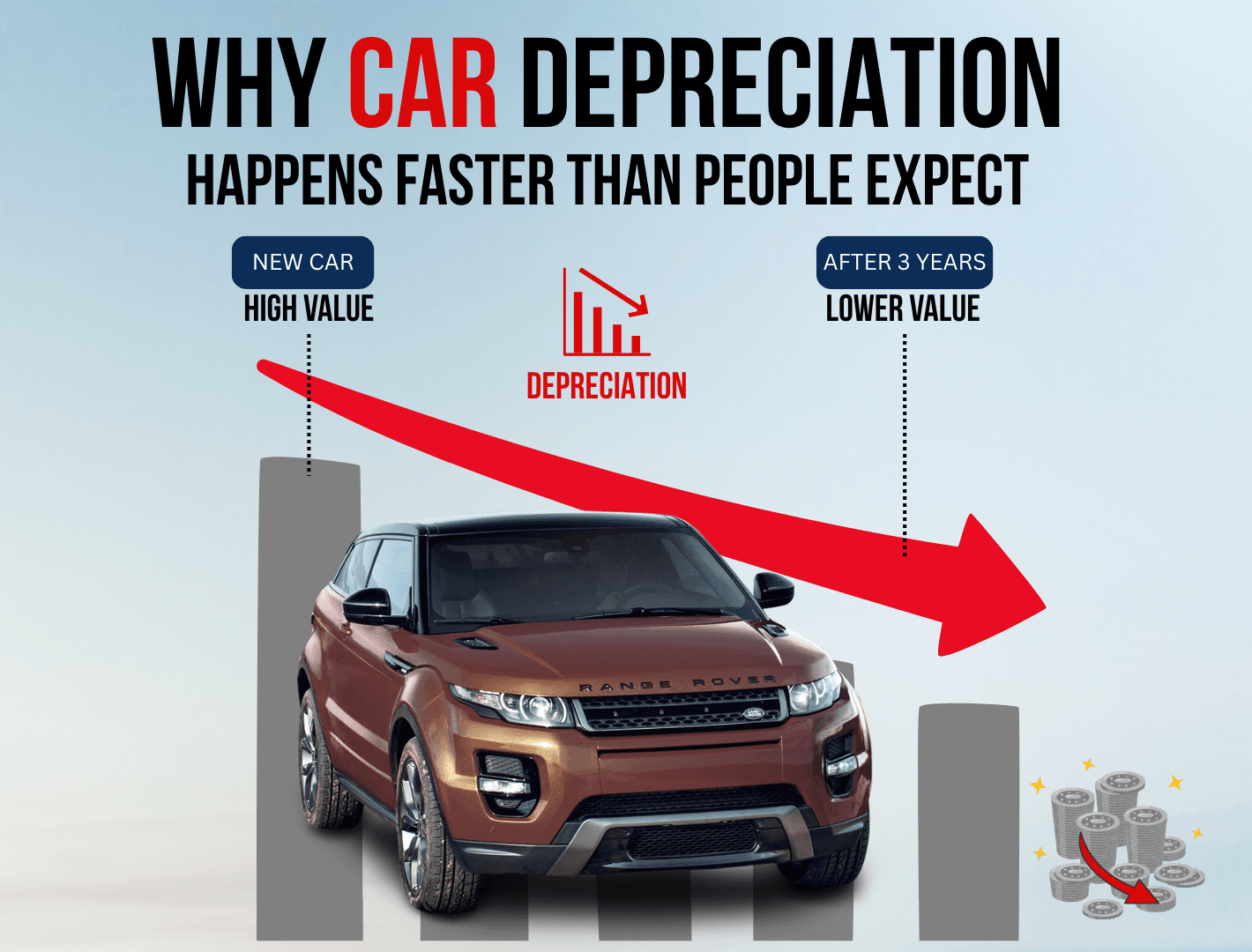
The moment value drops faster than emotion
Do you know that research shows a new vehicle can lose around 10–20% of its value within the first year itself, sometimes even more immediately after leaving the dealership?
This is not a slow decline. It is front-loaded.
And that is what surprises most owners.
Because emotionally, a new purchase feels like a “start.”
But financially, a car immediately enters a downward curve the moment ownership changes.
The key reason is simple: the market no longer treats it as new.
The hidden “instant used” effect
The biggest reason behind rapid depreciation is classification.
The moment a vehicle is registered in your name, it becomes “used” in the market—even if it has only driven 10 kilometers.
This shift alone can reduce value sharply because buyers automatically compare it with brand-new showroom stock.
You might still see a perfect finish, zero scratches, and a fresh cabin.
But the market sees history.
And history always changes price.
Supply, perception, and the psychology of trust
Here is something most people don’t think about.
When someone buys a used vehicle, they are not just buying metal and engineering—they are buying trust.
- Was it driven harshly?
- Was it maintained properly?
- Was it ever damaged and repaired?
- What is the hidden condition?
Because of this uncertainty, buyers naturally discount value.
Even a well-maintained car loses pricing power simply because it is no longer “unknown.”
This trust gap is one of the strongest forces behind depreciation.
Why the first year hurts the most
Do you know that depreciation is not evenly spread?
Studies show that the steepest drop happens in the early years, especially the first 1–3 years, where value can fall drastically before stabilizing later .
Why?
Because:
- The “new premium” disappears instantly
- Warranty advantage reduces perceived risk for used buyers
- New models enter the market every year
- Demand shifts toward newer features
So even if nothing is wrong with your vehicle, time alone reduces appeal.
Mileage quietly destroys value faster than age
Let’s talk about something very practical.
Two identical vehicles, same model, same year—but one has 20,000 km and the other has 60,000 km.
The difference in resale value can be significant.
Because mileage represents usage intensity.
Higher mileage signals:
- More engine wear
- Higher maintenance risk
- Shorter remaining lifespan
So even if your car is mechanically perfect, numbers on the odometer quietly influence buyer decisions.
Condition is not just cosmetic—it is financial
You might think scratches, dents, or faded paint are only visual issues.
But they directly affect valuation.
A minor accident record or repaint can reduce resale value because it signals potential structural risk—even if repairs were done perfectly.
Insurance and market reports even recognize “diminished value” after accidents, where a repaired vehicle still sells lower than an untouched one .
So yes, appearance is not vanity in resale—it is money.
The emotional disconnect most owners face
Here is where things get interesting.
People emotionally value their vehicle based on:
- Memories attached
- Comfort of ownership
- Maintenance effort
- Personal attachment
But the market values it based on:
- Age
- Mileage
- Demand
- Replacement cost
This mismatch is why depreciation feels “faster than expected.”
Because emotionally, your car is still your story.
But financially, it is just an asset with reducing utility.
Technology cycles are speeding everything up
Do you notice how quickly new features appear now?
Touchscreens, ADAS systems, connected apps, hybrid engines—what was premium two years ago becomes standard today.
This rapid innovation makes older models feel outdated faster, even if they are perfectly functional.
So even without physical wear, perceived value drops.
This is a modern reason why depreciation feels sharper today than in the past.
Market comparison pressure
Another silent factor is competition.
When newer models launch with:
- Better mileage
- Improved safety
- Updated design
- Better financing deals
Older models automatically lose attention.
Even if your car is in great condition, it competes with newer expectations.
And markets rarely reward “good enough.” They reward “latest.”
Final thoughts
Depreciation is not just a financial concept—it is a timing mismatch between emotion and economics.
When you buy a vehicle, you experience excitement, pride, and ownership.
But the market immediately evaluates it through a different lens: usage, risk, and replacement value.
That gap is what makes depreciation feel sudden.
If there is one thing to take away, it is this:
A vehicle does not lose value because it is bad.
It loses value because it is no longer new in a market that constantly rewards “newness.”
And once that understanding settles in, the numbers stop feeling surprising—and start feeling predictable.
Because in reality, depreciation was never sudden.
We just don’t notice it until we look for it.